


Pneumatic System Design: Professional Engineering Guide and Proper System Setup
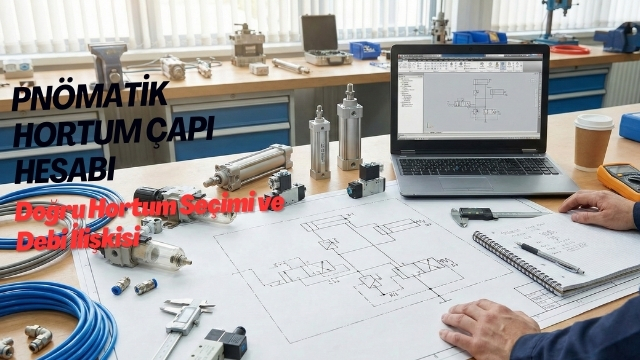
Pneumatic System Design
Professional Engineering Guide, Calculations and Industrial Applications
Pneumatic system design is a process where mechanical engineering, fluid mechanics and automation engineering intersect. A properly designed pneumatic system provides high efficiency, low energy consumption, long equipment life and reliable operation. Incorrect design leads to pressure loss, low force, control problems and high operating costs.
In this guide, we will examine pneumatic system design step by step using an engineering approach.
1. System Requirements Analysis
Before starting the design, system requirements must be clearly defined.
Main parameters to determine:
Required force (N)
Travel distance / stroke (mm)
Cycle time
Operating pressure (bar)
Ambient temperature / humidity
Duty cycle
Precision and speed requirements
These parameters form the basis of all component selections.
2. Force and Cylinder Sizing
Cylinder selection must be based on engineering calculation.
Basic Force Formula
F = P × A × η
F = Force (Newton)
P = Pressure (Pa)
A = Piston area (m²)
η = Efficiency (≈ 0.85 – 0.9)
Piston Area
A = π × r²
Example
Pressure = 6 bar
Diameter = 63 mm
A = 0.00311 m²
F ≈ 6×100000×0.00311×0.9 ≈ 1680 N
Note: Friction and mechanical losses must be considered.
Cylinder Force at 6 bar
| Diameter (mm) | Force (N) |
|---|---|
| 32 | 482 |
| 40 | 754 |
| 50 | 1177 |
| 63 | 1870 |
| 80 | 3015 |
| 100 | 4710 |
3. Air Consumption and Compressor Sizing
In pneumatic systems, a large portion of energy cost comes from air production.
Air Consumption
Q = A × L × N × P
Q = Air consumption
L = Stroke
N = Cycle rate
Compressor capacity = Total air consumption + 20% safety margin
Cylinder Air Consumption Example
| Diameter | Stroke | Cycle | Consumption |
|---|---|---|---|
| 50 mm | 100 mm | 20/min | 60 L/min |
| 63 mm | 100 mm | 20/min | 95 L/min |
| 80 mm | 100 mm | 20/min | 150 L/min |
4. Valve and Flow Selection
The main criterion in valve selection is flow capacity.
Insufficient flow → slow cylinder
Excessive flow → energy loss
Critical Parameters
Kv / Cv value
Port size
Response time
Control type (solenoid / pneumatic)
5. Pressure Drop Analysis
Pressure drop directly affects system performance.
Darcy–Weisbach
ΔP = f × (L/D) × (ρV² / 2)
Pressure drop must not exceed 10%.
Causes of Pressure Drop
Long hose
Small diameter
Valve resistance
Filter clogging
Leakage
6. Hose and Line Design
In industrial systems, line design is critical.
Design Rules
Long line → larger diameter
Avoid sudden restrictions
Minimize 90° bends
Zero leak tolerance
7. FRL and Air Quality
Contaminated air causes:
Valve failure
Cylinder wear
Pressure drop
Energy loss
Filtration Levels
40 µm → general
5 µm → precision
0.01 µm → instrumentation
8. Control and Automation Design
Modern pneumatic systems are controlled by PLC.
Circuit Types
Direction control circuit
Speed control circuit
Safety circuit
Synchronization circuit
9. Energy Efficiency
Energy loss in pneumatic systems:
30–40% → leakage
10–15% → pressure drop
10% → incorrect sizing
Optimization
Reduce pressure
Optimize flow
Eliminate leaks
Use efficient valves
10. Safety and Durability
Safety valve
Pressure sensor
Filter maintenance
Overload protection
11. Industrial Design Example
Application: Automatic pushing system
Cylinder: Ø63
Pressure: 6 bar
Valve: 5/2 solenoid
Flow: 800 L/min
Hose: 10 mm
Pressure drop: 6%
Result: Stable, fast and energy-efficient system.
12. Professional Design Rules
Pressure drop < 10%
Correct cylinder sizing
Calculate flow
Use FRL
Zero leakage
Conclusion
Pneumatic system design is the balance of force, flow, pressure, energy and automation. Engineering-based design improves system efficiency and minimizes failure risk.
To understand how pneumatic systems work, read How Pneumatic Systems Work. For detailed calculations, see Pneumatic System Calculations. To learn how pressure drop affects performance, read Pressure Drop in Pneumatic Systems.