


How Does a Pneumatic System Work? Step-by-Step Working Principle
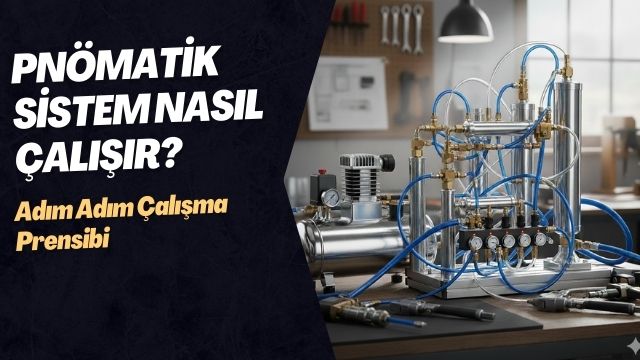
How Does a Pneumatic System Work? Step-by-Step Working Principle
Pneumatic systems generate mechanical motion using compressed air. They are widely preferred in industry due to their fast, reliable and clean operation. In this article, we examine step by step how a pneumatic system works.
1. Air Generation (Compressor)
The first stage is air generation. The compressor compresses atmospheric air and produces compressed air. The air is stored in an air tank and used according to system demand.
2. Air Preparation (FRL Unit)
Before entering the system, compressed air passes through filter, regulator and lubricator:
Filter → Removes dust and moisture
Regulator → Adjusts pressure
Lubricator → Lubricates moving parts
This stage is critical for system life and efficiency.
3. Control Stage (Pneumatic Valves)
Pneumatic valves determine the direction of airflow. Common valve types:
3/2 Valve
5/2 Valve
5/3 Valve
Valves can be electrically, mechanically or pneumatically actuated.
4. Motion Generation (Pneumatic Cylinder)
Compressed air enters the cylinder and creates force on the piston, producing linear motion.
Force formula:
F = P × A
5. Exhaust
Used air is released to the atmosphere through a silencer, reducing noise and ensuring smooth operation.
Pneumatic Cycle
Air generation → Air preparation → Control → Motion → Exhaust
Energy Efficiency
The biggest energy loss is air leakage. Preventing leaks improves efficiency significantly.
Applications
Automation machines
Packaging machines
Robotics
Conveyors
Automotive production
Conclusion
Pneumatic systems provide efficient and reliable automation with a simple working principle.
For reliable pneumatic system performance, selecting the correct components is essential. You can browse our product categories including pneumatic cylinders, solenoid valves, and air preparation (FRL) units to find suitable solutions for your application.